
Beetroot Powder and Altitude Training: The Science: The Short Answer
Beetroot's dietary nitrate works better at altitude because its nitrate-nitrite-nitric oxide pathway is oxygen-independent and becomes more active under hypoxia, exactly when the oxygen-dependent eNOS pathway is suppressed. At 2,000 meters, oxygen partial pressure drops from 159 to about 133 mmHg and SpO2 falls toward 90 to 94 percent. Take 1 serving 60 to 90 minutes before key sessions, and avoid antibacterial mouthwash, which blocks nitrate conversion.
Elite cycling and running teams that conduct altitude training camps increasingly include dietary nitrate as a standard protocol component. The reason is straightforward: at elevation, where oxygen partial pressure is lower than at sea level, the mechanisms through which dietary nitrate improves performance are amplified.
This post explains why altitude makes dietary nitrate more effective, what the research shows, and how to implement a practical protocol for athletes training or competing above 1,500 meters.
Why Altitude Creates a Performance Problem
Oxygen partial pressure falls from about 159 mmHg at sea level to roughly 133 mmHg at 2,000 meters and around 110 mmHg at 3,000 meters, dropping blood oxygen saturation (SpO2) from about 98 percent toward 90 to 94 percent. Working muscles receive less oxygen per liter of blood, heart rate rises at a given power output, and maximum sustainable effort drops measurably within the first days at elevation.
| Altitude | Oxygen partial pressure | Typical SpO2 |
|---|---|---|
| Sea level | ~159 mmHg | ~98% |
| 2,000 meters (6,560 ft) | ~133 mmHg | 90 to 94% |
| 3,000 meters (9,840 ft) | ~110 mmHg | Lower, athlete-dependent |
The practical consequence for endurance athletes: the blood leaves the lungs less fully saturated with oxygen, and the working muscles receive less oxygen per liter of blood delivered. Cardiac output increases to compensate, heart rate at a given power rises, and maximum sustainable effort decreases.
For a cyclist who can hold 350 watts for an hour at sea level, the same perceived effort at 2,500 meters might yield 310 to 320 watts. For a marathon runner, the 3:00 per kilometer pace that feels controlled at sea level requires noticeably more effort at altitude. This performance decrement is the fundamental problem that altitude acclimatization attempts to solve over 2 to 4 weeks. Athletes mapping out travel and race-day logistics for an elevation event can run their specific numbers through the race blueprint tool to see how altitude and heat compound on race day.
How Dietary Nitrate Helps at Altitude
Dietary nitrate's oxygen economy benefit is especially relevant at altitude because it works through an oxygen-independent pathway, exactly when the body's oxygen-dependent nitric oxide production (via eNOS) is suppressed by reduced tissue oxygen. Trained cyclists given dietary nitrate before a simulated 2,500-meter time trial showed a larger performance improvement than the same dose produced at sea level, evidence that the ergogenic effect scales with altitude rather than staying flat.
Nitric oxide (NO) is produced through two pathways in the body. The enzymatic pathway, involving nitric oxide synthase (eNOS), uses oxygen as a substrate. At altitude, reduced tissue oxygen availability impairs eNOS activity and reduces enzymatic NO production.
The second pathway, the nitrate-nitrite-nitric oxide pathway, is oxygen-independent. Dietary nitrate is reduced to nitrite by bacteria in the mouth, and nitrite is then converted to nitric oxide in the stomach and tissues through reactions that do not require oxygen. Under hypoxic (low-oxygen) conditions, this pathway becomes more active, not less.
The practical implication: when altitude suppresses the oxygen-dependent NO production pathway, dietary nitrate supplementation maintains nitric oxide availability through the complementary oxygen-independent route. The nitric oxide that would normally be lost due to altitude-induced hypoxia is partially restored through dietary nitrate intake. For the full mechanism behind why this matters for endurance output at any elevation, see how beetroot powder and nitric oxide affect athletic performance.
A 2015 study by Muggeridge et al. demonstrated this mechanism directly. Trained cyclists who consumed dietary nitrate before a time trial at simulated altitude (2,500 meters) showed improved performance compared to placebo, with a greater effect at altitude than at sea level. The researchers attributed the amplified effect to the upregulation of the nitrate-to-nitrite-to-NO pathway under hypoxic conditions.
The Altitude Training Camp Protocol
Altitude training camps typically run 2,000 to 3,500 meters for 2 to 4 weeks, and dietary nitrate supplementation is most useful in two distinct phases: the arrival and early adaptation window (days 1 to 7), and the taper back to sea level (2 to 4 weeks after return). Race day at altitude uses the same 3-day loading protocol as sea-level competition.
| Phase | Timing | Why | Protocol |
|---|---|---|---|
| Arrival and early adaptation | Days 1 to 7 of camp | SpO2 is at its lowest relative to sea-level baseline; EPO is ramping but red blood cell mass has not yet increased | 1 serving per day, 60 to 90 minutes before the key training session |
| Taper and return to sea level | 2 to 4 weeks after returning home | Elevated red blood cell mass from altitude stacks with the hemodynamic benefit of dietary nitrate while adaptation is expressing at sea level | Continue daily dietary nitrate use |
| Racing at altitude | Any race above 2,000 meters | Same evidence base as sea-level competition applies | 3-day loading (one AM plus one PM serving), then 1 serving 60 to 90 minutes before the start |
Dietary nitrate is most valuable during the toughest early days of a camp, when cardiac output is working hardest to compensate for reduced oxygen delivery and the hematological adaptation has not yet caught up.
See the complete loading protocol for all timing and dosing details, or work through the heat acclimation planner if your altitude camp or race also carries a heat load, a common combination at mountain venues in summer.
What Elite Teams Actually Do
Multiple WorldTour cycling teams have disclosed, through athlete interviews and team nutritionist presentations, that dietary nitrate (as beet juice concentrate or a standardized extract) is used daily throughout altitude camps specifically to maintain oxygen delivery during the low-acclimatization phase. This daily-use pattern, not a single race-day dose, is what separates altitude protocols from standard sea-level loading.
These disclosures come from sports science conference presentations and athlete interviews rather than a single published team-wide study, but the pattern is consistent across the programs that have spoken publicly about their altitude camp nutrition.
The Kenyan and Ethiopian running programs that have historically dominated altitude-adapted distance running are typically based in regions where the local diet is naturally high in dietary nitrate from leafy vegetables and root vegetables. Whether this dietary nitrate contributes to their altitude tolerance is an open question, but the coincidence has not escaped the attention of sports scientists.
Altitude-Specific Considerations
Three factors specific to altitude change how dietary nitrate should be managed: antibacterial mouthwash blunts the nitrate-to-nitrite conversion that matters more at elevation, dehydration slows gastric emptying and delays onset, and low ferritin (below 30 mcg per liter) limits the separate hematological adaptation nitrate does not replace. Address all three before relying on a nitrate protocol at altitude.
Mouthwash: The oral bacteria responsible for converting dietary nitrate to nitrite are suppressed by antibacterial mouthwash. At altitude, where the nitrate-to-NO pathway is especially important, using antibacterial mouthwash on training days would blunt the supplement's effectiveness more than at sea level. Avoid antibacterial mouthwash entirely during altitude blocks.
Hydration: Altitude increases respiratory water loss and often increases urine output. Dietary nitrate absorption is not affected by hypohydration at levels commonly seen in altitude athletes, but gastric emptying slows with dehydration, which can delay the onset of effect. Maintain normal hydration and take your serving with 300 to 500 mL of water.
Iron status: Iron deficiency impairs hemoglobin synthesis and limits the altitude adaptation response. Dietary nitrate does not substitute for adequate iron status. If you are altitude training for the hematological benefit, verify your ferritin levels are adequate (ideally above 30 mcg per liter) before the camp.
Complementary Supplements at Altitude
The IOC recognizes dietary nitrate as one of five evidence-based supplements for endurance athletes, and the remaining four, including caffeine, creatine, and beta-alanine, stay relevant at altitude rather than being displaced by it. Caffeine's CNS effect is not blunted by hypoxia, and beta-alanine needs 4 to 6 weeks of loading before camp starts to reach maximal carnosine buffering capacity.
- Caffeine: retains its CNS performance effects at altitude and is not blunted by hypoxia.
- Creatine: supports the high-intensity efforts in interval sessions at altitude, where phosphocreatine recycling is relevant.
- Beta-alanine (via Endurance360): load for 4 to 6 weeks before an altitude camp to ensure maximal carnosine buffering capacity during the demanding early acclimatization sessions.
See the IOC supplement overview for the full picture, and what limits the stamina of endurance athletes for how these mechanisms interact with oxygen delivery more broadly.
How Beetroot Pro Delivers a Disclosed Dose
A 2021 review of 28 commercial beet products found nitrate content ranging from 4.3 mg to 495.7 mg per serving, with most products falling well below the 300 mg clinical threshold used in the altitude research above. At elevation, where every milligram of nitrate-derived nitric oxide matters more than it does at sea level, a sub-clinical or undisclosed dose delivers effectively no ergogenic benefit.
| Product category | Nitrate content per serving | Meets clinical threshold (300 mg+)? |
|---|---|---|
| Low-end commercial beet products | 4.3 mg | No |
| Typical commercial beet products | Well under 300 mg | Usually not |
| High-end commercial beet products | Up to 495.7 mg | Yes, but inconsistently disclosed |
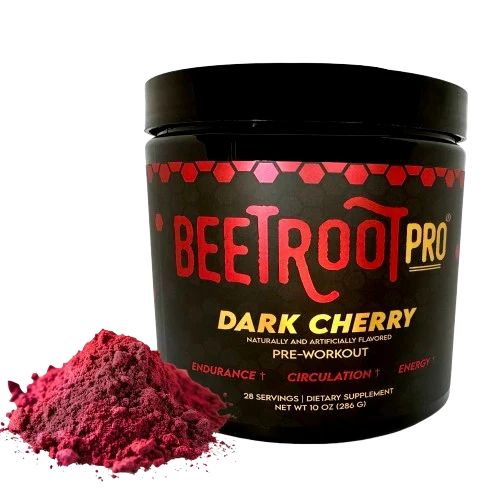
| Beetroot Pro® | About 160 mg, derived from a disclosed 8,000 mg extract at 2% | No, but the figure is derivable |
At altitude, where every milligram of nitrate-derived NO matters, using a product that delivers an undisclosed or sub-clinical dose is the same as using no product at all. Beetroot Pro® discloses an 8,000 mg standardized beet extract on its Supplement Facts panel. The panel prints no nitrate figure, but at the 2% standardization that extract carries, a serving works out to roughly 160 mg of dietary nitrate, below the 300 to 600 mg used in published trials and a number you can derive rather than guess at.
Compare dose transparency across product formats at the supplement comparison page, or read more on the health benefits of beetroot powder for the broader evidence base behind standardized nitrate dosing.
FDA Disclaimer: These statements have not been evaluated by the Food and Drug Administration. This product is not intended to diagnose, treat, cure, or prevent any disease.
Technical
Beetroot Pro
- Patented betaine nitrate
- Acute Oxygen Efficiency
- Low Sugar / Oxalate Free
Technical FAQ Extension
Why does dietary nitrate work better at altitude than at sea level?
At altitude, low tissue oxygen impairs the enzymatic (eNOS) pathway that needs oxygen to make nitric oxide. The nitrate-nitrite-nitric oxide pathway is oxygen-independent and becomes more active under hypoxic conditions, so dietary nitrate partially restores the nitric oxide that altitude would otherwise reduce. A 2015 study by Muggeridge et al. found a greater performance effect at simulated 2,500 meters than at sea level.
How should I use beetroot powder during an altitude training camp?
During the arrival and early adaptation window (days 1 to 7), take 1 serving per day, 60 to 90 minutes before your key training session, since this is the period of maximum performance decrement. For racing at altitude, use a 3-day loading protocol (one AM plus one PM serving) followed by one serving 60 to 90 minutes before the start.
Can I use mouthwash when taking beetroot powder at altitude?
No, avoid antibacterial mouthwash entirely during altitude blocks. Oral bacteria convert dietary nitrate to nitrite, the first step in the nitrate-to-nitric-oxide pathway. Because that pathway is especially important at altitude, antibacterial mouthwash on training days would blunt the supplement's effectiveness even more than it does at sea level. Plain water rinsing is fine.
Continue reading
Related Articles

Jul 25, 2026
Beetroot Powder as a Pre-Workout: Does It Replace Stimulants?
Beetroot powder works as a pre-workout through vasodilation, not stimulation. Here is the mechanism, the dosing window, and when it beats (or loses to) caffeine.

Jul 16, 2026
How Long Beetroot Powder Takes to Lower Blood Pressure
A single dose raises plasma nitrite in about 45 minutes and lowers blood pressure within 60 to 150 minutes. Here is the full timeline, by product format, and how daily use changes it.

Jul 14, 2026
Beetroot Powder for Blood Pressure: Dose and Brands
Beetroot powder can lower systolic blood pressure 4 to 10 mmHg, but only at a real nitrate dose. See how Beetroot Pro, SuperBeets, and Xendurance compare.
*Technical citations and PubMed references are provided for performance education only. These statements have not been evaluated by the FDA.