
Rhodiola Rosea for Endurance Athletes: The Evidence: The Short Answer
Rhodiola rosea is an adaptogen that lowers rate of perceived exertion, blunts the cortisol response to heavy training, and improves time to exhaustion by roughly 2 to 6 percent. It is chronic, not acute: most studies showing benefits used 4 to 6 weeks of consistent use. Effective dose is 100 to 200 mg of standardized extract (3 percent rosavins, 1 percent salidroside), and it should be cycled 8 to 12 weeks on, 2 weeks off.
Rhodiola rosea has gone mainstream in endurance communities, largely on the strength of Andrew Huberman's repeated recommendations on his podcast. He describes taking 100 to 200mg before workouts to reduce the perceived difficulty of exercise. The r/HubermanLab community, which has over 150,000 members, has generated hundreds of threads on the topic since 2022.
That visibility is well-earned. Rhodiola's performance and recovery effects have real research behind them. But the way it is typically discussed online creates two problems: people expect it to work like caffeine (immediately and acutely), and they do not know what to do about cycling.
This article covers what rhodiola actually does, the evidence behind it, how to use it correctly, and why it is one of the two adaptogen components in Endurance360.
What Rhodiola Does
Rhodiola rosea lowers rate of perceived exertion, blunts the cortisol spike from heavy training, and improves time to exhaustion by roughly 2 to 6 percent in controlled studies. It works by helping the body regulate the HPA (hypothalamic-pituitary-adrenal) stress axis rather than by stimulating the nervous system directly. The effect builds over 4 to 6 weeks of consistent use, not a single dose.
Rhodiola rosea is an adaptogen, which means its primary function is helping the body maintain homeostasis under stress. For endurance athletes, that stress is a high training load. Here is what the research shows:
| Effect | What the research found | Source |
|---|---|---|
| Lower rate of perceived exertion (RPE) | Athletes felt like they were working less hard at the same submaximal pace | 2004, International Journal of Sport Nutrition and Exercise Metabolism |
| Blunted cortisol response | Reduced cortisol spike from training stress via HPA-axis regulation | 2009, Journal of Strength and Conditioning Research |
| Improved time to exhaustion | 2 to 6 percent improvement at a fixed workload | Multiple controlled studies |
| Better inter-session recovery | Fewer reported "dead legs" days during high-training-load blocks | Downstream effect of cortisol blunting |
This is the effect Andrew Huberman is referencing when he describes workouts feeling easier: not a stimulant kick, but a dampened stress response that lets a hard session feel more manageable while the actual physiological cost stays the same or improves.
What Rhodiola Does NOT Do
Rhodiola rosea is not a stimulant, does not produce an acute energy spike like caffeine, and does not work on a single dose. Most controlled studies showing performance benefits used 4 to 6 weeks of consistent daily use before measuring results. It also does not replace training: it helps the body absorb and recover from load that is already being applied.
This is important for setting the right expectations before you start.
- Not a stimulant. Some people report mild alertness, but this is not its primary mechanism and it varies by individual. Feeling nothing acutely does not mean it is not working.
- Not immediate. The HPA-axis adaptation that drives the RPE and cortisol effects takes weeks to build. This is a chronic, cycled supplement, not a pre-race acute one.
- Not a replacement for training. Rhodiola helps you absorb and recover from a training load; it does not generate fitness in the absence of that load. The athletes who benefit most are those already training at high volumes.
When Does Endurance360 Start Working?
Adaptogens are chronic supplements. The timeline below shows what to expect week by week.
Beta-alanine tingling confirms active dosing. Adaptogens begin HPA-axis engagement.
First recovery signals. Cortisol response starts moderating during hard sessions.
Carnosine stores rising. Rhodiola cortisol blunting measurable. Threshold feels more sustainable.
Peak cellular saturation. VO2 max economy improved. This is the target window for key events.
Rhodiola cycling note: After 8 to 12 weeks, take a 2-week break from rhodiola to prevent adaptation. Creatine and beta-alanine do not require cycling.
The Huberman Protocol
Andrew Huberman's public recommendation is 100 to 200 mg of standardized rhodiola rosea extract taken 10 to 20 minutes before a demanding workout, framed as a way to reduce the psychological and physiological cost of hard sessions. The protocol is consistent with the clinical research on dose and standardization. The main caveat is that the extract must be standardized to specific rosavin and salidroside percentages, not raw rhodiola powder.
This protocol is reasonable and consistent with the research. A few notes:
| Variable | Recommendation |
|---|---|
| Dose | 100 to 200 mg of standardized extract |
| Standardization | 3 percent rosavins, 1 percent salidroside (the primary bioactive compounds) |
| Timing | 10 to 20 minutes before a demanding workout |
| Frequency | Daily during a training block is a valid approach; consistency matters more than timing precision |
| Time of day | Morning or early afternoon preferred; some athletes find it mildly stimulating and avoid it before evening sessions |
Non-standardized "rhodiola powder" may not deliver the same effect at the same dose, since the rosavin and salidroside content is what the clinical trials actually dosed against.
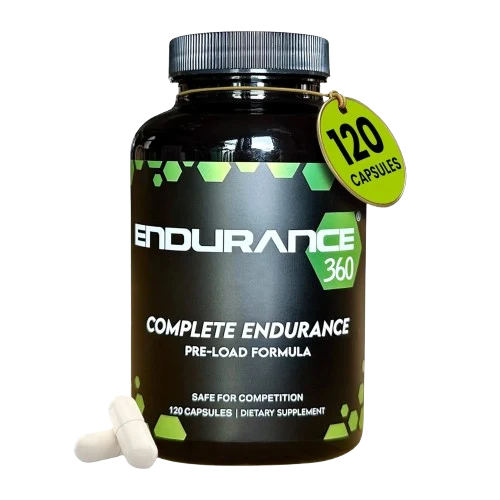
Endurance360® includes standardized Rhodiola Rosea extract alongside CS-4 Cordyceps in its 1,200mg Cellular Oxygenation blend, delivering the RPE reduction and cortisol-blunting effects from the research. The full formula also covers creatine for ATP regeneration and beta-alanine for lactate buffering, so the adaptogen layer compounds with the muscular endurance layer in one daily dose.
Shop Endurance360®Do You Need to Cycle Rhodiola?
Yes. Rhodiola rosea should be cycled 8 to 12 weeks on followed by a 2-week break, because adaptogens can lose effectiveness with uninterrupted continuous use. This does not mean rhodiola stops working after 8 weeks; it means a periodic rest period prevents diminishing returns and lets the body's stress-response systems reset. Creatine and beta-alanine, the other key Endurance360 compounds, do not require cycling.
Rhodiola is an adaptogen, and adaptogens can lose effectiveness over time if taken continuously without a break. The mechanism is not perfectly understood, but the practical recommendation from both traditional use and clinical experience is:
| Phase | Duration | What to do |
|---|---|---|
| On-cycle | 8 to 12 weeks | Take rhodiola daily alongside training |
| Off-cycle | 2 weeks | Stop rhodiola; continue training as normal |
| Best timing for the break | Planned recovery weeks or off-season | Lets the rest period double as a training deload |
Creatine and beta-alanine (the other key compounds in Endurance360) do not require cycling. You can take Endurance360 continuously through a full training block and simply allow a natural break between training cycles.
Timing that 2-week break against your actual race calendar, rather than an arbitrary date, is the part most athletes get wrong. The Endurance360 loading plan tool and the adaptogen timing guide both map the rhodiola on/off cycle against a specific race date, so the break lands during a scheduled down week instead of colliding with a taper or a key training block.
Rhodiola in Endurance360
Endurance360® includes standardized Rhodiola Rosea extract as part of a 1,200 mg Cellular Oxygenation blend alongside Cordyceps mycelium extract; the individual rhodiola dose within that blend is not broken out on the label. Athletes who need to verify an exact per-serving milligram figure should use a standalone rhodiola supplement instead, at the cost of losing Endurance360's broader amino acid matrix.
- Blend size: 1,200 mg total, Cellular Oxygenation blend (rhodiola + cordyceps combined)
- Individual rhodiola dose: not disclosed (proprietary blend, standard practice for multi-ingredient formulas)
- Extract type: standardized rhodiola extract, consistent with the dosing used in the clinical studies above
- Additional matrix: creatine, beta-alanine, L-Carnosine, Taurine, L-Arginine HCl, L-Methionine, L-Tyrosine
It is worth being honest about the label limitation: you cannot verify the exact milligrams of rhodiola per serving from the label alone. What we can confirm is that the Cellular Oxygenation blend delivers 1,200mg total across rhodiola and cordyceps, and that the formula uses a standardized rhodiola extract. Cordyceps carries its own separate evidence base worth understanding on its own terms; see the breakdown of cordyceps mycelium versus fruiting body extract for how that half of the blend is sourced.
If you require a product where you know the exact rhodiola dose per serving, buying a standalone rhodiola supplement is a valid option. The trade-off is that you lose the full amino acid matrix that you get in Endurance360. That matrix supports neuromuscular function and ATP resynthesis in ways that two standalone adaptogen capsules cannot replicate.
Summary
Rhodiola rosea is a chronic, cycled adaptogen: 100 to 200 mg of standardized extract daily for 4 to 6 weeks before effects appear, run in 8 to 12 week blocks with a 2-week break, delivering a 2 to 6 percent improvement in time to exhaustion alongside lower RPE and blunted cortisol. It is not a stimulant and not a substitute for training volume.
Rhodiola rosea is one of the better-supported adaptogens for endurance performance. The evidence for RPE reduction, cortisol blunting, and time-to-exhaustion improvements is real. It is a chronic supplement that requires 4 to 6 weeks of consistent use before the effects are measurable, and it benefits from a cycling protocol (8 to 12 weeks on, 2 weeks off) to prevent adaptation.
For endurance athletes already training at meaningful volumes, rhodiola is a legitimate addition to a performance protocol. It is not a stimulant, it is not instant, and it works best when layered into a complete formula alongside the other compounds that support muscular endurance and recovery. Use the adaptogen timing guide to build a rhodiola and cordyceps cycle around a specific race date rather than guessing at the on/off weeks.
Technical FAQ Extension
What does rhodiola rosea do for endurance athletes?
Rhodiola is an adaptogen that helps the body maintain homeostasis under high training load. The research shows it reduces rate of perceived exertion during submaximal exercise, blunts the cortisol response to training stress by regulating the HPA axis, and improves time to exhaustion with effect sizes ranging from 2 to 6 percent. It also supports recovery between sessions.
How long does rhodiola take to start working?
Rhodiola is a chronic supplement, not an acute pre-race one. Most controlled studies showing performance benefits used supplementation periods of 4 to 6 weeks, because the HPA-axis adaptation takes time to build. It is not a stimulant, so if you take it and feel nothing immediately, that does not mean it is not working.
Do I need to cycle rhodiola, and how?
Yes. Adaptogens can lose effectiveness if taken continuously without a break, so the practical recommendation is 8 to 12 weeks on followed by a 2-week break. This does not mean rhodiola stops working after 8 weeks; the rest period helps prevent diminishing returns and lets the stress-response systems reset. Many athletes time breaks to recovery weeks or the off-season.
Continue reading
Related Articles
Jun 3, 2026
Best Leg Cramp Supplements for Endurance Athletes
The 5 supplements that prevent leg cramps: magnesium, potassium, beta-alanine, creatine, and taurine, with clinical doses and loading timelines.
Jan 30, 2023
Magnesium for Endurance Athletes: Dose and Sweat Loss
How much magnesium endurance athletes need, why sweat losses create a deficit, and the daily dose shown to raise peak oxygen uptake in trained athletes.

Jun 2, 2026
Vitamin D3 and K2 Benefits for Endurance Athletes (2026)
Vitamin D3 supports muscle and immune health; K2 directs calcium to bone, not arteries. Combined D3+K2 is a high-value daily supplement for endurance athletes.
Complete
Endurance 360
- Chronic Lactic Acid Buffering
- ATP & Cellular Saturation
- Cordyceps & Adaptogen Matrix
*Technical citations and PubMed references are provided for performance education only. These statements have not been evaluated by the FDA.