Potassium for Leg Cramps: Does It Actually Work?
Potassium deficiency directly causes leg cramps in endurance athletes by disrupting the electrical potential that allows muscle cells to relax after contracting. Supplementing 200 to 400 mg of potassium daily, alongside magnesium, sodium, and calcium, reduces cramping frequency. Potassium alone is not sufficient because leg cramps in trained athletes also have a neuromuscular fatigue component that requires beta-alanine and creatine to address.
Potassium for Leg Cramps: Does It Actually Work for Athletes?
Any cyclist who has woken up at 2 AM with a calf muscle locked in a full cramp has probably been told to eat a banana. The advice is not wrong, but it is incomplete. Potassium does play a direct role in leg cramp prevention, and most endurance athletes are running low on it after long summer rides. The question is whether potassium alone is enough, and the answer, after years of testing this with other endurance athletes, is no.
Here is what the research actually shows, how potassium fits into a complete anti-cramp protocol, and what to take if you want to stop cramping for real.
How Potassium Causes Leg Cramps When It Runs Low
Potassium is the primary intracellular electrolyte in muscle cells, and it controls the electrical gradient that allows a muscle to relax after contracting. When potassium drops from sweat loss, the resting membrane potential of the muscle cell destabilizes, making it easier to trigger an involuntary contraction and harder to turn it off. The result is a cramp: a contraction that fires spontaneously and will not release.
Your muscles contract and relax through a cycle driven by electrical charges crossing the cell membrane. Potassium (positive charge, inside the cell) and sodium (positive charge, outside the cell) create a voltage difference that resets after each contraction. When potassium falls, the reset is slower and less complete, which means the cell is sitting closer to the firing threshold even at rest.
During a 3 to 5 hour ride in summer heat, a 160-pound athlete can lose 300 to 600 mg of potassium through sweat. That is a meaningful fraction of the 3,500 to 4,700 mg daily recommended intake, and it accumulates over multi-day training blocks faster than diet typically replenishes it.
What the Research Shows on Potassium for Leg Cramps
Multiple studies confirm that potassium deficiency (hypokalemia) is a reliable predictor of exercise-associated muscle cramping in athletes. Supplementing potassium as part of a full electrolyte protocol significantly reduces cramping frequency in endurance athletes, particularly in hot conditions where sweat loss is highest. The key word is "protocol": potassium works best as part of a combined approach, not as a standalone fix.
The challenge with using potassium research directly is that most controlled studies on exercise-associated muscle cramps (EAMC) involve combined electrolyte interventions because athletes lose multiple minerals simultaneously. Isolating potassium from sodium, magnesium, and calcium is difficult in a real training environment.
What the research does show clearly:
- Athletes with low dietary potassium cramp more frequently than those with adequate intake
- Potassium supplementation reduces nocturnal leg cramps (the after-ride calf lockup) in athletes with deficiency
- The combination of potassium and magnesium is more effective than either alone, because both are lost in sweat and both are required for normal muscle cell electrical function
Potassium vs Magnesium: Which Matters More for Athletes?
Both potassium and magnesium are essential for leg cramp prevention in endurance athletes, but they work through different mechanisms. Potassium sets the electrical resting state of the muscle cell; magnesium governs the calcium pumps that physically trigger relaxation after a contraction. Deficiency in either one produces cramping. The strongest approach addresses both simultaneously.
| Mineral | Role in Muscle Function | Typical Sweat Loss (per hour, hard effort) | Daily Target for Athletes |
|---|---|---|---|
| Potassium | Membrane potential, relaxation signal | 150 to 400 mg | 3,500 to 4,700 mg |
| Magnesium | Calcium pump regulation, nerve signal modulation | 50 to 100 mg | 400 to 500 mg |
| Sodium | Fluid balance, nerve signal transmission | 500 to 1,500 mg | Variable by sweat rate |
| Calcium | Muscle contraction trigger | 20 to 60 mg | 1,000 to 1,200 mg |
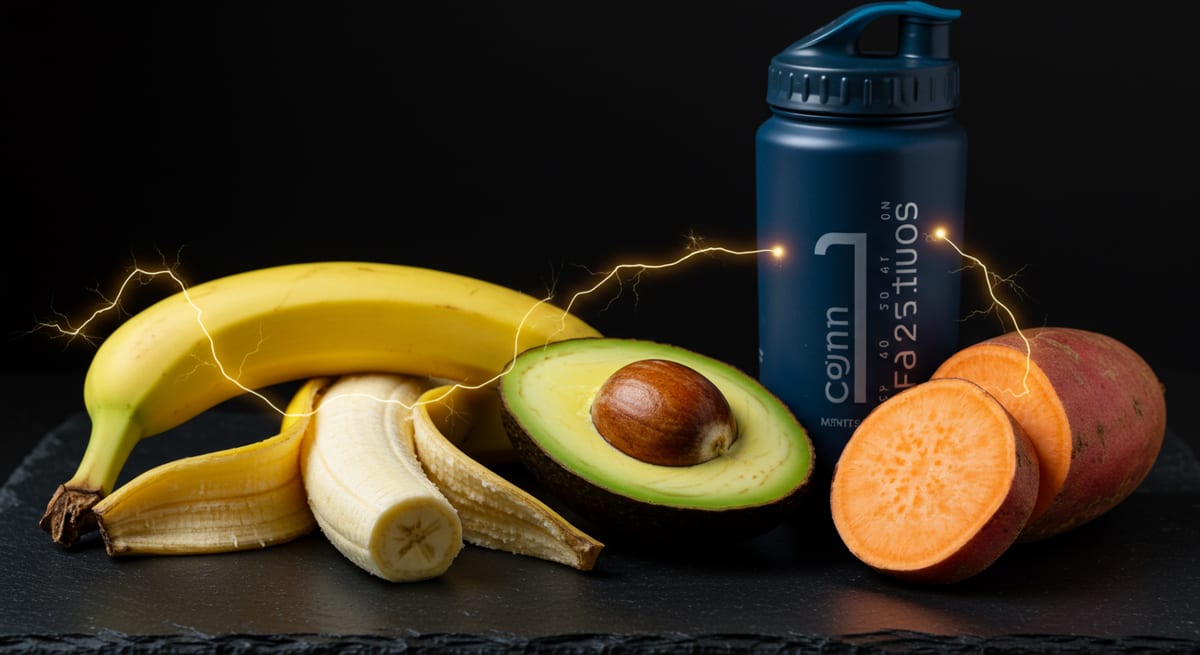
Magnesium gets more attention in the research because magnesium deficiency is more widespread in the general population and because magnesium supplementation is better studied. But potassium deficiency is at least as common in endurance athletes who train heavily in summer heat, and it is often underaddressed because athletes rely on food sources (bananas, sweet potatoes, avocado) that are slow to replenish training-induced losses.
Why Potassium and Magnesium Are Not the Complete Solution
Electrolyte replenishment addresses the depletion side of leg cramping, but research on highly trained endurance athletes increasingly shows that neuromuscular fatigue, not electrolyte loss, is the dominant cramping mechanism in fit athletes. Sustained effort over hours fatigues the inhibitory signaling in your spinal cord that prevents runaway muscle firing. No amount of potassium fixes a fatigued nervous system.
This distinction matters when you are a trained cyclist who eats well, stays hydrated, and still cramps at mile 70 of a century. Your electrolytes may be fine. What is failing is the neuromuscular control layer.
The supplements that address neuromuscular fatigue cramping are different from the electrolyte supplements:
- Beta-alanine raises muscle carnosine, buffering the acidity that lowers the cramp threshold during high-intensity efforts
- Creatine monohydrate accelerates ATP regeneration, reducing the metabolic stress that drives neuromuscular fatigue
- Taurine stabilizes calcium signaling inside muscle cells and supports osmoregulation
These require a loading phase of 10 to 14 days minimum. You cannot take them the morning of a race and expect a benefit. The athletes who never cramp on long summer rides are typically running both the electrolyte protocol and the neuromuscular loading protocol concurrently.
The Complete Leg Cramp Protocol for Endurance Athletes
The most effective approach covers both mechanisms. Here is what this looks like in practice:
Daily baseline (electrolytes, no loading required):
- Magnesium: 300 to 400 mg elemental (glycinate or malate form for absorption)
- Potassium: 200 to 400 mg supplemental (in addition to dietary sources)
- Sodium: addressed through food and intra-ride nutrition
- Taurine: 1 to 2 g daily
Loading protocol (neuromuscular, 10 to 14 days before target event):
- Beta-alanine: 3.2 to 6.4 g daily
- Creatine monohydrate: 3 to 5 g daily
Running all of these individually means five separate supplements with different dose timing and formats. Endurance360 Complete combines all five in a single daily dose, formulated at the ranges used in endurance athlete research. The 14-day loading plan walks through the start-date protocol relative to your goal event.
What Athletes Using Endurance360 Report on Cramping
These are verified purchaser reviews:
"Since I started using Endurance360 every day I have been free from leg cramps at night after long hard rides and races."
"I experience far less fatigue, cramping and lactic acid build up. On 100 or 200-mile rides, I have learned that Endurance 360 is a must for me."
"I work outdoors in the heat and this product is very effective in reducing leg cramps when taken after work."
The pattern in these reviews is consistent: athletes who load E360 for 2 or more weeks before their hardest training blocks stop getting the after-ride calf cramps that previously disrupted their sleep and recovery.
FAQ
How much potassium do I need to stop leg cramps?
Most athletes cramping from potassium depletion need 200 to 400 mg of supplemental potassium daily on top of dietary sources, particularly during heavy training blocks in summer. The upper limit for supplemental potassium is typically 99 mg per capsule under US regulations, so food sources (bananas, sweet potatoes, spinach) and combined supplement formulas that include potassium in a matrix with other electrolytes are the practical way to reach adequate levels.
Does eating a banana before a ride prevent leg cramps?
Partially. A medium banana contains roughly 420 mg of potassium, which helps, but a single banana before a 4-hour ride in heat cannot replace potassium lost through sweat (up to 400 mg per hour in hard efforts). It also does nothing for the neuromuscular fatigue component of cramping that develops over long efforts.
Is potassium or magnesium better for leg cramps?
Both are required. Potassium controls the electrical state of the muscle cell membrane; magnesium governs the calcium pumps that allow the muscle to relax. Deficiency in either one produces cramping through slightly different mechanisms. Supplementing one without the other leaves half the problem unaddressed.
Why do I cramp on long rides even when I drink plenty of electrolytes?
If you are staying hydrated, taking electrolytes during the ride, and still cramping, the likely cause is neuromuscular fatigue rather than acute electrolyte depletion. This mechanism requires a different intervention: beta-alanine and creatine loaded over 10 to 14 days before the event, not electrolytes taken during it.
The Bottom Line
Potassium for leg cramps is real science, not folk medicine. Potassium deficiency is one of the direct causes of exercise-associated muscle cramping, and supplementing it as part of a full electrolyte protocol reduces cramping frequency in endurance athletes. But it addresses only the electrolyte half of the equation.
If you have tried electrolytes and still cramp on long summer rides, the missing piece is almost certainly the neuromuscular fatigue pathway. Endurance360 Complete addresses both: the full electrolyte matrix (potassium, magnesium, sodium, calcium) and the neuromuscular loading ingredients (beta-alanine, creatine, taurine) in a single daily protocol.
Start the loading block now, and your legs will be in a different place by the time your next big event arrives.
Continue reading
Related Articles

Jun 3, 2026
Does Creatine Cause Leg Cramps? The Evidence
The myth that creatine causes leg cramps is not supported by evidence; studies show the opposite. What the research says and what athletes should know.
Apr 13, 2026
Potassium for Endurance Athletes: Cramps and Daily Targets
Potassium drives muscle contraction, fluid balance, and nerve signaling. Endurance athletes lose 100 to 300 mg per hour in sweat. How much to replace, and when.
Jun 3, 2026
Best Supplements for Leg Cramps in Endurance Athletes (2026)
The 5 supplements that prevent leg cramps in cyclists, runners, and triathletes, ranked by evidence: magnesium, potassium, beta-alanine, creatine, taurine.
Complete
Endurance 360
- Chronic Lactic Acid Buffering
- ATP & Cellular Saturation
- Cordyceps & Adaptogen Matrix
*Technical citations and PubMed references are provided for performance education only. These statements have not been evaluated by the FDA.