
Why does nitric oxide drop during menopause?
Menopause adds a second hit on top of aging. eNOS activity already declines roughly 50 percent between ages 25 and 60. Estrogen directly upregulates eNOS, so when estrogen falls during menopause, eNOS activity drops further. The result is a double deficit: normal age-related decline plus an additional drop from estrogen loss.
The Compounding NO Deficit
The masters athlete page on Beetroot Pro documents that endothelial nitric oxide synthase (eNOS) activity declines roughly 50 percent between ages 25 and 60. This is the age-related NO deficit that all athletes face, regardless of sex.
For female athletes, perimenopause and menopause add a second independent hit. Estrogen is a direct upregulator of eNOS. When estrogen declines during menopause, eNOS activity drops further, compounding the age-related decline. The result is a double deficit: the normal age-related eNOS decline plus an additional drop from estrogen loss.
Why Nitrate is Uniquely Valuable for This Population
Dietary nitrate from beetroot works through the nitrate-nitrite-NO pathway. This pathway is independent of eNOS. Oral bacteria convert dietary nitrate to nitrite, which is then absorbed into circulation and converted to nitric oxide through various enzymatic pathways that do not depend on eNOS.
This means beetroot nitrate provides a bypass around both the age-related eNOS decline and the estrogen-loss deficit. For female athletes over 40, this makes dietary nitrate a uniquely valuable intervention. Where the bodys endogenous NO production is compromised through two independent mechanisms, the dietary pathway remains fully functional.
Practical Protocol for Athletes Over 40
The standard masters 5-day loading protocol applies, but female athletes over 40 may benefit from an adjusted approach.
Daily Baseline: Maintain a daily serving of beetroot nitrate year-round, not just during race weeks. This keeps plasma nitrate above baseline and supports training adaptation consistently.
Race Week Loading: Use the 5-day loading protocol (one serving AM and PM for 5 days before race morning) plus one serving 60 to 90 minutes before the start.
High-Volume Training: On days with two sessions, a second serving before the PM session can help with recovery and maintain vasodilation for the second workout.
Year-Round vs. Cycling: Unlike some supplements that require cycling, daily nitrate use is safe year-round and does not require cycling. The benefit is maintained with consistent dosing.
Beyond Performance: Health Span Considerations
For female athletes over 40, nitric oxide supports more than just race-day performance. NO is essential for cardiovascular health, cognitive function (cerebral blood flow), and bone remodeling. The eNOS-independent benefit of dietary nitrate extends beyond athletic performance into long-term health span.
References
- Taddei S, et al. Age-related reduction of NO availability and oxidative stress in humans. Hypertension. 2001.
- Tanaka H, Seals DR. Endurance exercise performance in Masters athletes. Journal of Physiology. 2008.
- Jones AM. Dietary nitrate supplementation and exercise performance. Sports Medicine. 2014.
- Govoni M, et al. The increase in plasma nitrite after a dietary nitrate load is markedly attenuated by an antibacterial mouthwash. Nitric Oxide. 2008.
Why does nitric oxide drop during menopause?
Menopause adds a second hit on top of aging. eNOS activity already declines roughly 50 percent between ages 25 and 60. Estrogen directly upregulates eNOS, so when estrogen falls during menopause, eNOS activity drops further. The result is a double deficit: normal age-related decline plus an additional drop from estrogen loss.
Why is beetroot nitrate especially valuable for athletes over 40?
Dietary nitrate works through the eNOS-independent nitrate-nitrite-NO pathway, so it bypasses both the age-related eNOS decline and the estrogen-loss deficit. Where the body's endogenous NO production is compromised through two independent mechanisms, the dietary pathway remains fully functional, making nitrate a uniquely valuable intervention for female masters athletes.
Should I take beetroot nitrate every day or only on race weeks?
A daily baseline serving year-round keeps plasma nitrate above baseline and supports training adaptation consistently. For races, use the 5-day loading protocol (one serving AM and PM for 5 days) plus one serving 60 to 90 minutes before the start. Daily nitrate use is safe year-round and does not require cycling.
Continue reading
Related Articles

Apr 13, 2026
Beetroot Powder, Nitric Oxide, and Endurance
Nitrate from beetroot converts to nitric oxide, widening blood vessels and improving oxygen delivery to muscle. Peak effect is 60 to 90 minutes post-dose.

May 15, 2026
Can Beetroot Nitrate Support Female Athlete Triad Recovery?
The Female Athlete Triad has a vascular side: low estrogen compromises NO-mediated blood flow, hurting recovery and bone remodeling. How nitrate may help.

May 15, 2026
Female-Specific Beetroot Nitrate Dosing
The standard 300 to 600 mg nitrate dose was validated in men. Body-weight-adjusted dosing may suit female athletes better. Here is what the research says.
Technical
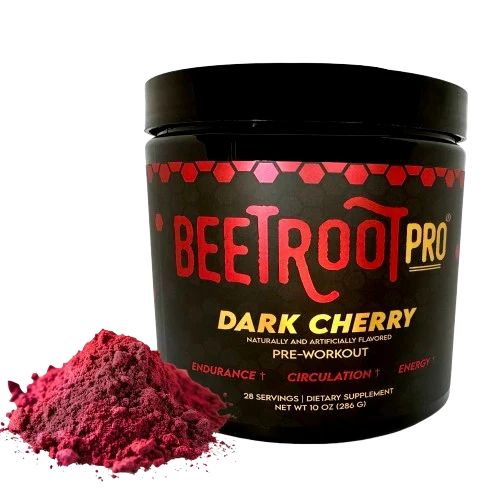
Beetroot Pro
- Patented betaine nitrate
- Acute Oxygen Efficiency
- Low Sugar / Oxalate Free
*Technical citations and PubMed references are provided for performance education only. These statements have not been evaluated by the FDA.